Books by Aria Farjadi
Publications
Methods from the teaching room — on sight-reading, memory, presence and life at the piano.

The Art of Sight-Reading at the Piano
Prima Vista · A Complete Method
13 languages as e-book · 8 also on Kindle and in print
See contents
- Preface: Sight-reading is not a talent
- How to use this book
- The six pillars of the method
- Chapter 1: Saccades, fixations and the eye-hand span
- Chapter 2: Audiation — the inner ear as a prediction engine
- Chapter 3: Meter, subdivision and polyrhythm
- Chapter 4: Syncopation, metric modulation and rhythmic chunking
- Chapter 5: Key signatures, scale geometry and keyboard topography
- Chapter 6: Proprioception and blind-reading
- Chapter 7: Anticipatory fingering and hand mechanics
- Chapter 8: Dense chromaticism, double accidentals and modulation
- Chapter 9: Chord geometry and visual harmonic recognition
- Chapter 10: Linear patterns — scales, arpeggios and Alberti bass
- Chapter 11: Ledger lines and the benchmark anchor system
- Chapter 12: Polyphony, voice separation and dynamic layering
- Chapter 13: Stylistic decoding
- Chapter 14: Technical risk management and tempo selection
- Chapter 15: Pre-play — the ten-second mental protocol
- Chapter 16: Live execution, error-burying and buffer control
- Chapter 17: The Farjadi 365-day curriculum
- Farjadi Progression System™
- Appendix A · Diagnostic troubleshooting table
- Appendix B · Glossary of sight-reading terminology
- Appendix C · Assessment rubric and testing protocol
- Appendix D · Photocopiable worksheets
- Appendix E · Graded repertoire list, levels 1–8
- Appendix F · Graded examinations — step by step
- About FARJADI PIANO SCHOOL
The Art of Memorisation at the Piano
How to memorise piano music
English · Danish · e-book
See contents
- Preface: Playing from memory is not a gift
- How to use this book
- The five memories: the foundation of the method
- Chapter 1: The five memories and the redundancy principle
- Chapter 2: Why memory fails on stage
- Chapter 3: Working memory, consolidation and the forgetting curve
- Chapter 4: Chunking — from single notes to meaningful units
- Chapter 5: Harmonic and melodic patterns as vocabulary
- Chapter 6: The architecture of form — phrases, sequences and repeats
- Chapter 7: Visual pattern recognition in the score
- Chapter 8: The myth and the reality of photographic memory
- Chapter 9: Photographing the page — the concrete technique
- Chapter 10: The map of the keyboard — spatial memory
- Chapter 11: Mental practice — playing with your eyes closed
- Chapter 12: Harmonic analysis as a memory anchor
- Chapter 13: Formal analysis — the skeleton of the piece
- Chapter 14: The bubble map — the memory map of the piece
- Chapter 15: Verbal encoding — naming and narrating
- Chapter 16: Audiation — the inner ear
- Chapter 17: Motor memory built correctly
- Chapter 18: Farjadi Memory Progression — encoding, consolidation, retrieval
- Chapter 19: The stock progressions — chord successions your ear already knows
- Chapter 20: Music without functional harmony
- Chapter 21: Counterpoint — when the voices must be remembered separately
- Chapter 22: Remembering together with others
- Chapter 23: The three seconds after a blackout
- Chapter 24: Coming back — the piece you knew a year ago
- Chapter 25: How much can you keep alive?
- Chapter 26: Shadow study — reading the piece without having it in front of you
- Farjadi Memorisation Protocols
- Appendix A · Diagnostic: which memory is failing?
- Appendix B · Memorisation checklist before the stage
- Appendix C · Graded repertoire by memorisation difficulty
- Appendix D · Photocopiable worksheets
- About the author
When the Music Falls Silent
On the emptiness after the concert, the desire that fades, and the way back to the piano
English · Danish · e-book
See contents
- Preface: The silence no one warns you about
- How to read this book
- Chapter 1: When the music falls silent
- Chapter 2: The strange emptiness after the concert
- Chapter 3: When the goal has been reached
- Chapter 4: When discipline turns into compulsion
- Chapter 5: The paradox — desire and guilt
- Chapter 6: Burning a piece
- Chapter 7: When is a piece finished?
- Chapter 8: The art of letting music rest
- Chapter 9: When you come back
- Chapter 10: The Return — coming back
- Chapter 11: Play something you are not supposed to master
- Chapter 12: The small session — XS to XL
- Chapter 13: Motivation does not always come first
- Chapter 14: The musician needs a life too
- Chapter 15: The trap of perfection
- Chapter 16: Look back — the credit you never give yourself
- Chapter 17: When the concert becomes a beginning
- Chapter 18: Your musical energy
- Chapter 19: The Farjadi principle
- Chapter 20: A new way to practise
- Chapter 21: When the desire returns
- Chapter 22: A musical life in balance
- Chapter 23: To the teacher
- Chapter 24: To the adult pianist
- Chapter 25: To the professional musician
- Chapter 26: Move the piece — and hear what you could not hear
- Chapter 27: To the one who stopped
- Chapter 28: When people stop asking
- Chapter 29: When there is nothing to repair
- Chapter 30: The Return — one note at a time
- Epilogue: The music must be able to survive you
- One last exercise
- About FARJADI PIANO SCHOOL
- About the author
Solresol
The Language You Can Play
English · Danish · e-book
See contents
- Welcome
- Chapter 1 · The Man Who Wanted the World to Sing Together
- Chapter 2 · The Seven Syllables — a Whole Language in One Scale
- Chapter 3 · Four Ways to Speak
- Chapter 4 · Sing the Language — Solfège, Ear Training and Hand Signs
- Chapter 5 · Your First Vocabulary
- Chapter 6 · The Grammar — Simpler Than You Think
- Chapter 7 · Dynamics and Contrasts — the Feelings of the Language
- Chapter 8 · Play the Language — Twelve Little Pieces
- Chapter 9 · Exercises — Decode and Translate
- Chapter 10 · Write Your First Message in Notes
- Glossary
- Answer Key
- Appendix A · Quick Reference
- Appendix B · Thirty Days with Solresol
- About the Author
Behind the Keys
Joy, discipline and balance as a pianist
Danish edition · original title: Bag Tangenterne · e-book
See contents (Danish)
- Forord: Dagen efter
- Sådan bruger du bogen
- Den kunstneriske cyklus: bogens fundament
- Kapitel 1: Den usynlige tomhed efter koncerten
- Kapitel 2: Hjernens fordøjelsesfase
- Kapitel 3: Genrejsningen — de fjorten dage tilbage til klaveret
- Kapitel 4: Fokus under præstation — bagspejlet og bjergtoppen
- Kapitel 5: Fejlens plads og perfektionismens pris
- Kapitel 6: Repertoirets livscyklus — den grønne banan
- Kapitel 7: Sinusbølgen — repertoirets fire faser
- Kapitel 8: Hverdagens disciplin — minimumsrutinen
- Kapitel 9: Den fysiske pianist — hænder, krop og søvn
- Kapitel 10: Din digitale sparebøsse
- Kapitel 11: Undervisning som kunstnerisk spejl
- Kapitel 12: Inspiration og det persiske ordsprog
- Kapitel 13: Øverummets ensomhed og det kollegiale fællesskab
- Kapitel 14: Tid, økonomi og et kunstnerliv der kan bæres
- Kapitel 15: Årshjulet — sæsonen planlagt med vilje
- Kapitel 16: Glæden — grunden til at du begyndte
- Farjadi Balanceprotokoller
- Appendiks A · Diagnostisk: hvad mangler du lige nu?
- Appendiks B · Fjorten dage efter koncerten
- Appendiks C · Ugentlig øve- og mentaldagbog
- Appendiks D · Repertoirets modningsskema
- Appendiks E · Årshjul og arbejdsark
- Om FARJADI PIANO SCHOOL
- Om forfatteren
The Intuitive Pianist
A series in six volumesSix short books on the body, the sound and the mind at the piano — from the moment before the first note to meeting the audience.
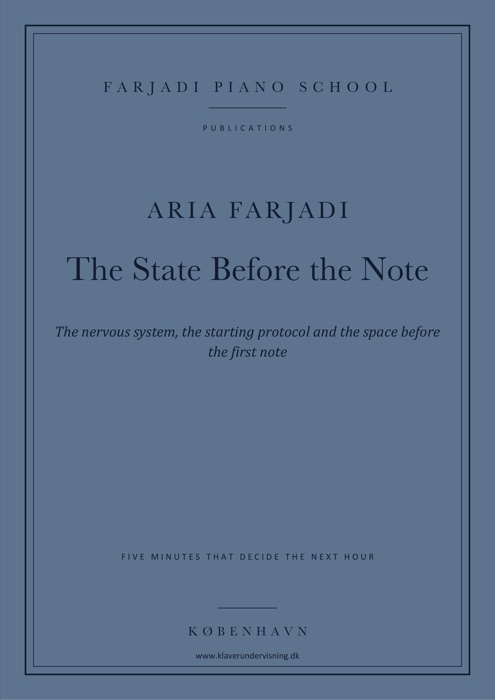 Volume 1
The State Before the Note
Google PlayKindleContents
- Preface: The silence before the note
- How to use this book
- The series: six volumes, one purpose
- Chapter 1: Hours are not work
- Chapter 2: When the sound turns hard and you do not know why
- Chapter 3: Desire as information
- Chapter 4: The unconscious first touch
- Chapter 5: Grounding — the feet, the sit bones, the spine
- Chapter 6: Square breathing
- Chapter 7: The physical anchor and the intention for the day
- Chapter 8: The protocol in practice — 3, 5 and 20 minutes
- Chapter 9: The note must be found before it is played
- Chapter 10: The three images
- Chapter 11: The activation touch
- Chapter 12: The resonance as a listening exercise
- Chapter 13: The quiet morning hour
- Chapter 14: What the night does to the day’s work
- Chapter 15: The closing protocol
- Chapter 16: The day when there is no time
- Chapter 17: When you are interrupted
- Chapter 18: The piano that stands in the living room
- Chapter 19: The warm-up — what it is actually for
- Chapter 20: After a break from the instrument
- Chapter 21: When the concentration does not come
- Chapter 22: Practising in the evening
- Chapter 23: Listening as work
- Chapter 24: To the teacher
- Chapter 25: Silence as material
- Chapter 26: The instrument you have
- Chapter 27: Working without an instrument
- Chapter 28: When you are your own teacher
- Chapter 29: What the protocol cannot do
- The starting protocol in three sizes: XS, S and M
- The quick card: three minutes from everyday life to sound
- About FARJADI PIANO SCHOOL
- About the Author
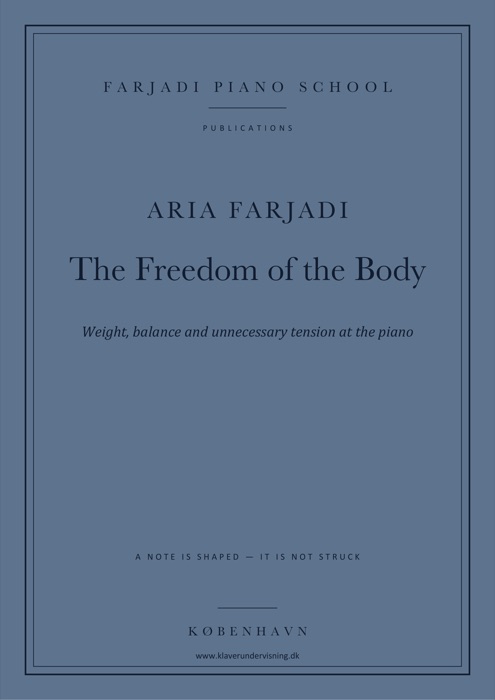 Volume 2
The Freedom of the Body
Google PlayKindleContents
- Preface: What you hold on to without knowing
- How to use this book
- Chapter 1: Unnecessary tension
- Chapter 2: The feet as foundation
- Chapter 3: The neck, the back and the balance of the head
- Chapter 4: Shoulders and arms that hang freely
- Chapter 5: The note comes from the arm, not from the finger
- Chapter 6: The springing wrist
- Chapter 7: The walk of the weight — legato as transferred gravity
- Chapter 8: What tension does to the sound
- Chapter 9: The micro-pause at the difficult place
- Chapter 10: The release — five minutes without an instrument
- Chapter 11: Silent overwriting
- Chapter 12: The five criteria
- Chapter 13: The hearing test — warm against cold sound
- Chapter 14: Octaves without holding on
- Chapter 15: The leap that is not to be hit
- Chapter 16: Fast runs and the hidden tension
- Chapter 17: Chords and the fall of the arm
- Chapter 18: The thumb
- Chapter 19: The place where you always tighten
- Chapter 20: The breaks in practice
- Chapter 21: When it hurts
- Chapter 22: Cold hands
- Chapter 23: The small hand
- Chapter 24: The bench, the pedal and the balance
- Chapter 25: To the teacher — seeing the tension
- Chapter 26: The body has to be warmed up too
- Chapter 27: The body over a musical life
- Chapter 28: The finger movement — how little it takes
- Chapter 29: The left hand
- Chapter 30: The trill and the small movements
- Chapter 31: The tension that comes from outside
- The body card: one page at the piano
- About FARJADI PIANO SCHOOL
- About the Author
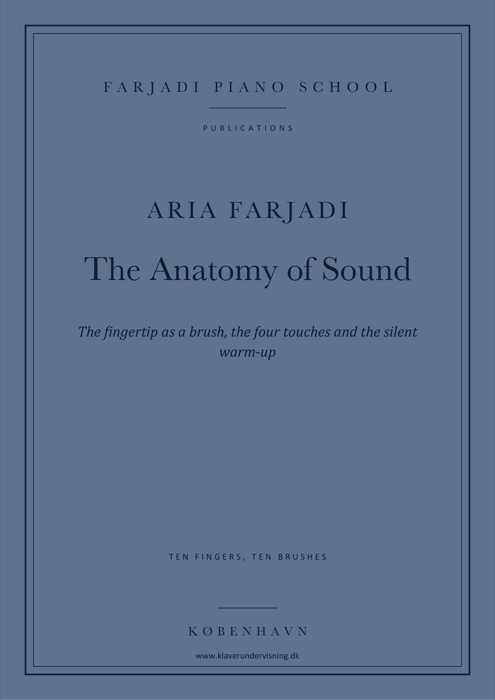 Volume 3
The Anatomy of Sound
Google PlayKindleContents
- Preface: The same piano, ten different sounds
- How to use this book
- Chapter 1: Ten fingers, ten brushes
- Chapter 2: The contact point — the flat and the steep brush
- Chapter 3: Tone colour is not volume
- Chapter 4: Feeling the key
- Chapter 5: Tonguing the key
- Chapter 6: The deep key
- Chapter 7: Eating the key
- Chapter 8: Choosing the touch according to the music
- Chapter 9: Escapement — where the key lets go
- Chapter 10: The silent warm-up in four steps
- Chapter 11: The weakest carrying note
- Chapter 12: The ten-coloured touch
- Chapter 13: Image, stroke, listening
- Chapter 14: Bringing out the melody — one finger with weight
- Chapter 15: The pedal as tone colour
- Chapter 16: Counterpoint — four hands in two
- Chapter 17: The singing line
- Chapter 18: The accompaniment that must not take up room
- Chapter 19: To the teacher — teaching sound
- Chapter 20: Sound on an unfamiliar instrument
- Chapter 21: The left pedal
- Chapter 22: The middle pedal
- Chapter 23: The different natures of the registers
- Chapter 24: The sound ideals of the styles
- Chapter 25: Dynamics as architecture
- Chapter 26: Sound in the room
- Chapter 27: Hearing your own sound
- Chapter 28: Sound as a signature
- Chapter 29: Legato without pedal
- Chapter 30: The repeated note
- Chapter 31: Sound in fast playing
- Chapter 32: What the piano does by itself
- The sound card: one page at the piano
- About FARJADI PIANO SCHOOL
- About the Author
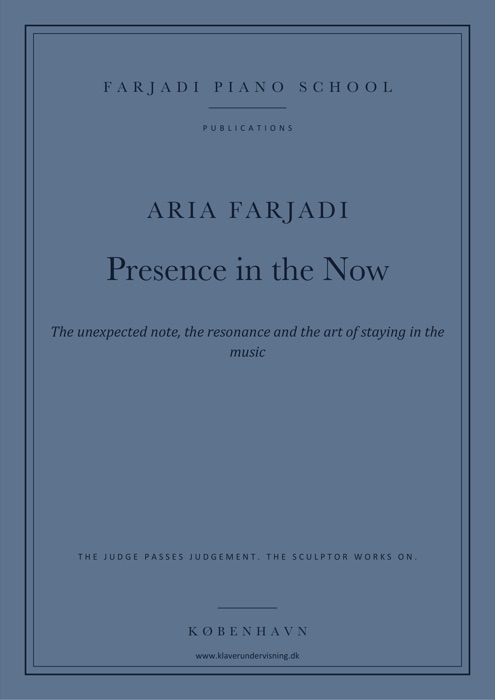 Volume 4
Presence in the Now
Google PlayKindleContents
- Preface: The half second after a wrong note
- How to use this book
- Chapter 1: The flight from the sound you did not want
- Chapter 2: The judge and the sculptor
- Chapter 3: Artistic acceptance
- Chapter 4: Reshape the Resonance
- Chapter 5: Early timing
- Chapter 6: Letting the note live
- Chapter 7: Unhurried sight-reading — the eyes stay on the page
- Chapter 8: Two bars ahead of the hand
- Chapter 9: Rhythmic continuity before individual notes
- Chapter 10: Anchor-based memorising — the four layers
- Chapter 11: Presence is a task, not a mood
- Chapter 12: The pulse that is not a metronome
- Chapter 13: Rubato — time that borrows and pays back
- Chapter 14: The rest
- Chapter 15: Beginning and ending
- Chapter 16: To the teacher — presence cannot be asked for
- Chapter 17: What is it about?
- Chapter 18: Character before detail
- Chapter 19: Choosing and leaving out
- Chapter 20: Recordings — poison and gift
- Chapter 21: When you do not know what you want
- Chapter 22: The piece you have played for too long
- Chapter 23: Presence in practice
- Chapter 24: Playing for yourself
- Chapter 25: Presence and memory
- Chapter 26: The days when it does not work
- Chapter 27: The music is now
- Chapter 28: Tempo — how to choose it
- Chapter 29: The repeat — what happens the second time
- Chapter 30: The ornaments
- Chapter 31: When you play for someone you know
- Chapter 32: Listening to rather than listening at
- The presence card: one page at the piano
- About FARJADI PIANO SCHOOL
- About the Author
 Volume 5
The Listening Repertoire
Google PlayKindleContents
- Preface: The piece that never gets finished
- How to use this book
- Chapter 1: Capacity is not the same as time
- Chapter 2: The four zones
- Chapter 3: Reading the zone — and getting it wrong
- Chapter 4: Building
- Chapter 5: Maturing
- Chapter 6: Concert-ready
- Chapter 7: The flow between the boxes
- Chapter 8: How much can be kept alive?
- Chapter 9: The maintenance that costs almost nothing
- Chapter 10: Putting a work down
- Chapter 11: The rhythm of the year
- Chapter 12: The music has to come from a person
- The repertoire card: one page at the piano
- Chapter 13: Choosing a work
- Chapter 14: Several works at once
- Chapter 15: The work that never got finished
- Chapter 16: The programme
- Chapter 17: To the teacher — the pupil’s repertoire
- Chapter 18: The week
- Chapter 19: When life takes over
- Chapter 20: Playing with others
- Chapter 21: The goals that are not concerts
- Chapter 22: The adult who begins
- Chapter 23: The years
- Chapter 24: Teaching as part of a musical life
- Chapter 25: The editions
- Chapter 26: Auditions and competitions
- Chapter 27: Putting something out
- Chapter 28: When you consider stopping
- Chapter 29: Why you began
- Chapter 30: What you can pass on
- Chapter 31: Improvisation and playing by ear
- Chapter 32: The music you do not play
- Chapter 33: The scores
- Afterword to the whole series
- About FARJADI PIANO SCHOOL
- About the Author
 Volume 6
The Stage
Google PlayContents
- Preface: The best dress rehearsal of your life
- How to use this book
- Chapter 1: The evening the body does something other than agreed
- Chapter 2: The reach of the hearing
- Chapter 3: The tonic is the present — music as a journey through time
- Chapter 4: Readiness at the wrong speed
- Chapter 5: The three kinds of nervousness
- Chapter 6: The myth of playing safe
- Chapter 7: The scenario you play out in your head
- Chapter 8: The reversed dress rehearsal
- Chapter 9: “I am someone who dries up”
- Chapter 10: The mistake as steering, not as verdict
- Chapter 11: Practising under pressure instead of only in calm
- Chapter 12: The cold test — find the places that break
- Chapter 13: The carry-on exercise
- Chapter 14: Is the programme ready? Four questions
- Chapter 15: The day of the concert, hour by hour
- Chapter 16: The last ten minutes in the green room
- Chapter 17: When it goes wrong in the middle of a movement
- Chapter 18: The restless week before
- Chapter 19: The week after
- Chapter 20: To the teacher
- Chapter 21: When you play with others
- Chapter 22: Coming back after a bad experience
- The stage card: one page for the green room
- About FARJADI PIANO SCHOOL
- About the Author
The e-books are sold on Google Play and can be read on phone, tablet and computer. Prima Vista is also available for Kindle and in print on Amazon.